MCP Servers in Algeria: What They Are, and How TKAWEN Built One
The Model Context Protocol (MCP) is the most important open standard to hit AI in years. Introduced by Anthropic in November 2024, it was adopted by OpenAI, Google and Microsoft within a single year and handed to the Linux Foundation. This guide explains what MCP and MCP servers are — with diagrams — and shows how an Algerian company, TKAWEN, built and published a real MCP server. It doubles as the first practical English reference on MCP in Algeria.

What is MCP?
MCP stands for Model Context Protocol. It is a free, open standard that lets AI applications — like Claude or ChatGPT — connect to external tools and data sources in a uniform way. Anthropic open-sourced it on 25 November 2024, alongside official SDKs for Python and TypeScript.
USB-C for AI
The popular analogy is that MCP is "USB-C for AI". Just as USB-C standardized how devices connect with a single cable, MCP standardizes how any AI model connects to any tool through one protocol. The full official reference lives at modelcontextprotocol.io.
The problem it solves: M×N integrations
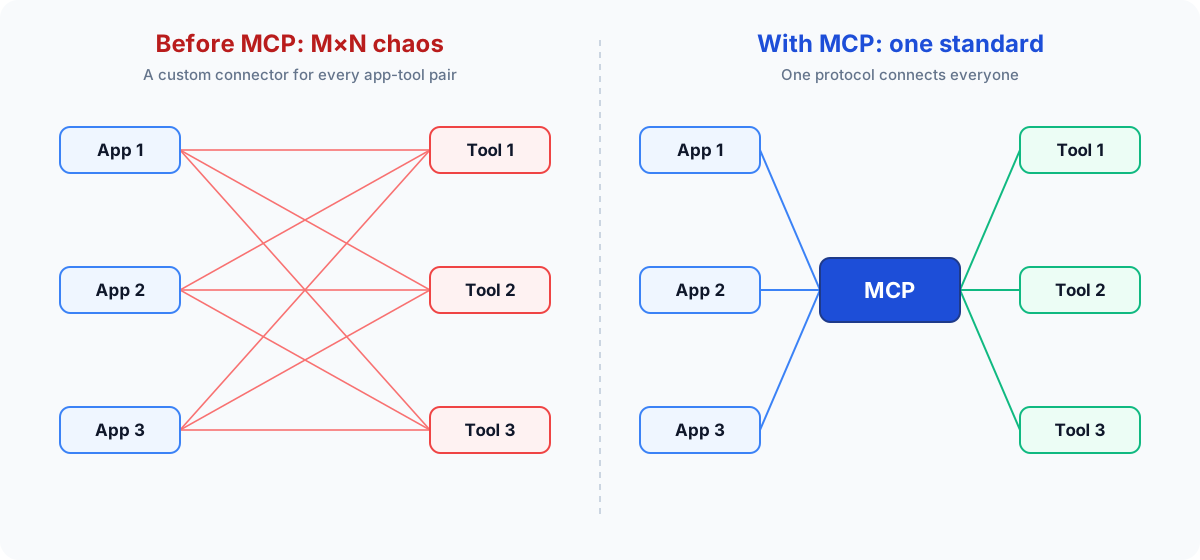
Before MCP, connecting M AI applications to N tools meant writing a custom connector for every pair — M×N separate integrations. Ten apps and ten tools meant one hundred brittle integrations. Engineers call this the "M×N problem", and it makes maintenance a nightmare and slows innovation.
MCP turns M×N into M+N: each app implements the protocol once, each tool exposes itself as an MCP server once, and everyone can talk to everyone. One standard integration instead of a hundred custom connectors.
How an MCP server works
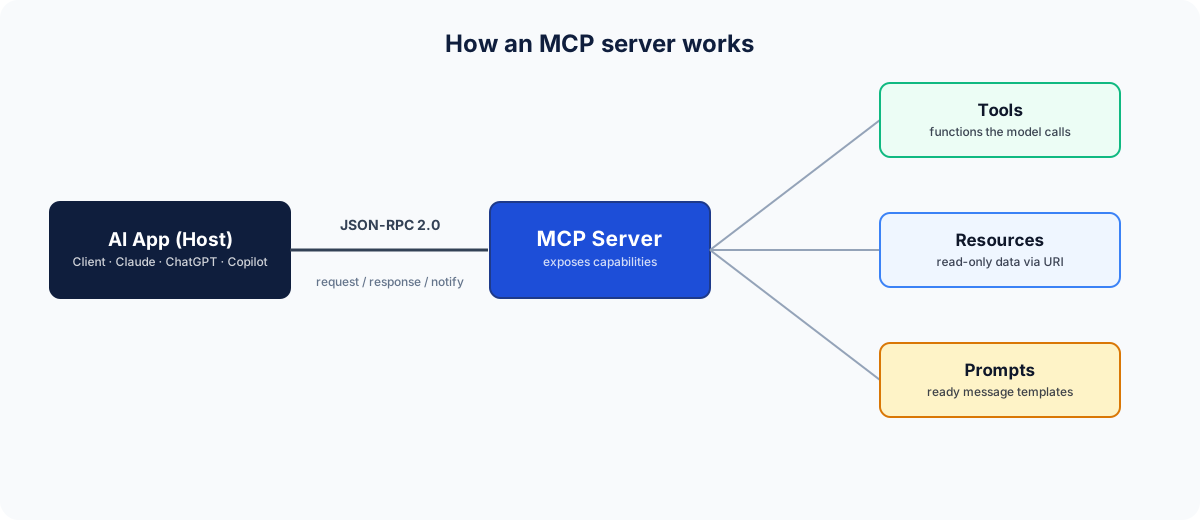
MCP uses a client-server architecture. The AI application (the host) opens a client session that connects to an MCP server over JSON-RPC 2.0 — lightweight, two-way messages (request, response, notification) that fit how models call tools dynamically.
Tools, Resources and Prompts
A server exposes three kinds of capability: Tools (functions the model can call), Resources (read-only data addressed via URIs), and Prompts (ready-made message templates). The model discovers these capabilities and invokes them as needed.
From experiment to industry standard in one year
In March 2025 OpenAI officially adopted MCP and added it to ChatGPT; Google DeepMind, Microsoft (which built an official C# SDK) and AWS followed. See the overview on Wikipedia.
By late 2025 Anthropic donated MCP to the Linux Foundation with OpenAI, Google and Microsoft as co-sponsors, so it stopped being "Anthropic's protocol" and became industry infrastructure. Reported figures include over 97 million monthly SDK downloads and more than 10,000 active MCP servers, per the official one-year review.
The Algeria angle: a first-mover opportunity
The standard is global and open, but its local application is nearly absent. There are barely any MCP servers exposing Algerian services — delivery, cash-on-delivery, certification, bookings — to AI assistants. Whoever builds these first becomes the infrastructure others build on.
A genuine blue ocean
A globally proven standard meeting an empty local market. Arabic-language content on MCP is almost non-existent too, so building and documenting early earns both search visibility and authority.
How TKAWEN built a real MCP server
We do not write about MCP from the outside. TKAWEN built a real MCP server for the ambulance platform ambulancedz.com and published it publicly on npm as @tkawen/ambulancedz-mcp. It exposes tools that let an AI assistant find and vet ambulance drivers, with a safety layer that controls what is allowed.
It reflects the wider TKAWEN philosophy: Algerian tools built locally that follow global standards as soon as they appear — from Mystoq for commerce to LIQAA for meetings. For the Arabic explainer, see ما هو MCP؟.
- @tkawen/ambulancedz-mcp — published publicly on npm (stable release).
- Tools: find and vet ambulance drivers.
- A safety layer governs what the model is allowed to do.
How to build your own MCP server
The path is practical. Learn the basics from modelcontextprotocol.io, then apply it to your own service: pick the single most important action (calculate delivery, create an order, verify a certificate), expose it as one MCP tool using the official Python or TypeScript SDK, add a safety layer, test it with a real client such as Claude, then publish and expand.
Start small and learn from real usage before scaling — the same principle behind every good product build.
Sources & references
Anthropic announcement: Introducing the Model Context Protocol.
Official site and docs: modelcontextprotocol.io and the architecture overview.
Encyclopedic overview: Model Context Protocol — Wikipedia.
TKAWEN's MCP server on npm: @tkawen/ambulancedz-mcp.
Algerian tools, built for the AI era
From e-commerce to certification to MCP servers, TKAWEN builds Algerian tools that follow global standards. Explore the ecosystem.
Discover TKAWENFAQ
What is an MCP server?
An MCP server exposes a tool or service's capabilities (as tools, resources and prompts) in a standard way that any compatible AI assistant can discover and call over the Model Context Protocol. It is how you make your product usable directly by AI apps like Claude or ChatGPT.
Is there a real MCP server from Algeria?
Yes. TKAWEN's @tkawen/ambulancedz-mcp is published publicly on npm and lets an AI assistant find and vet ambulance drivers — proof that an Algerian company can ship to the global standard today.
Is MCP free and open?
Yes. MCP is an open-source, free standard now governed by the Linux Foundation with Anthropic, OpenAI, Google and Microsoft as sponsors, so it is not owned by any single company.
How do I start building an MCP server?
Pick the most important action in your service, expose it as a single MCP tool using the official Python or TypeScript SDK, add a safety layer, test it with a real client like Claude, then publish and expand gradually.