Elderly Care (Auxiliaire de vie) in Algeria: The Job, Training, Work and Contracts
An auxiliaire de vie (care assistant) accompanies an older or dependent person in the activities of daily life: personal hygiene, getting around, meals, reminders about medication times, and human presence, without taking the place of the nurse or the doctor. In Algeria they work in private homes, in public homes for older persons run by the National Solidarity sector, and in licensed private establishments. This guide explains the profession in its Arabic and French terms, what Law 10-12 on the protection of older persons says, the skills you need to master, the training routes, how to read an employment contract, and the reality of working in France, without empty promises.
What does auxiliaire de vie mean in Arabic, and who does this work?
Auxiliaire de vie literally means "life assistant" (musaid/a al-hayat in Arabic), and Arabic also uses terms such as "elderly companion", "older-person care provider" and "home helper". The core of the job is the same: helping a person who can no longer carry out the basic tasks of daily life alone, while respecting their dignity and preserving the independence they still have.
Algerian law itself describes this situation: Article 20 of Law 10-12 defines a "dependent" older person (dépendante) as a person who needs the help of another person to carry out the basic tasks of daily life, or who needs regular supervision. This is exactly the field in which a care assistant works.
It is important to distinguish between the professions: a care assistant does not give injections, change medical dressings or adjust medication. These are the work of the nurse or the care aide (aide-soignant) under medical supervision. Their role is careful observation and prompt reporting.
The daily duties of a care assistant
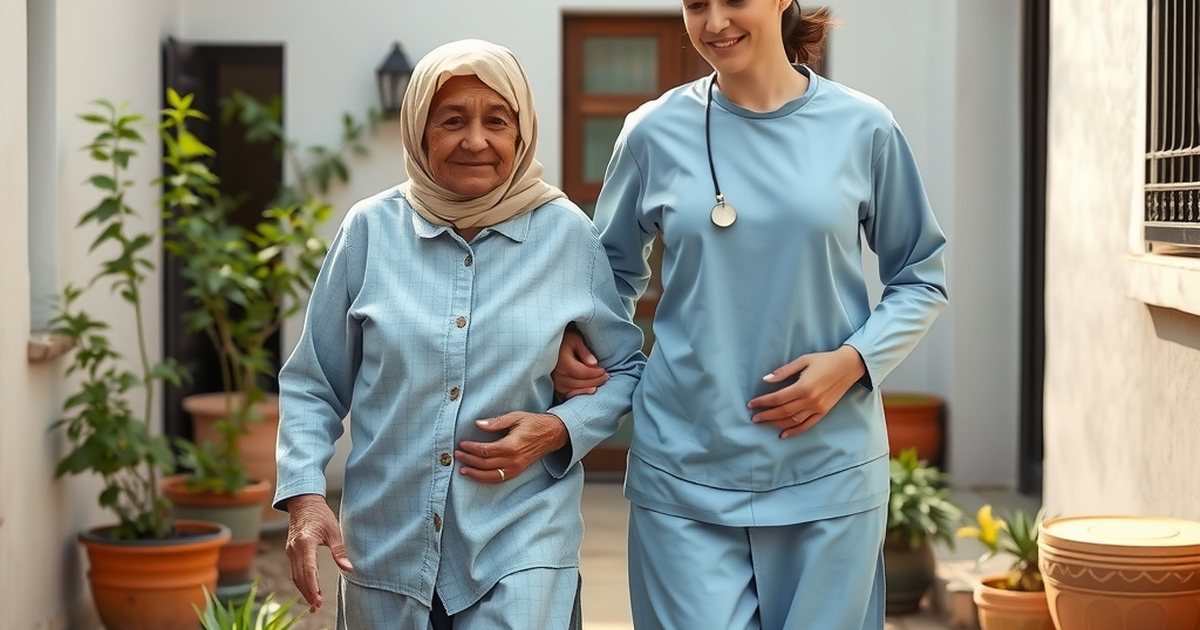
The details differ between a home and an institution, but the core duties are the same in both:
- Helping with personal hygiene, dressing and using the toilet, while respecting modesty and privacy.
- Helping the person to stand up, sit down and walk, and moving them safely from the bed to the chair.
- Preparing meals suited to the diet set by the doctor, and helping with eating and drinking.
- Reminding the person of medication times as prescribed by the doctor, without changing doses.
- Accompanying the person to medical appointments and outings, and organising their day.
- Talking, listening and simple activities to break isolation.
- Noticing any change (new confusion, loss of appetite, a fall, redness of the skin) and informing the family or the medical team immediately.
At home
The work is usually solitary: you are alone with the older person for hours and deal directly with the family. Trust, honesty and the ability to act in an emergency are what keep you in the job.
In a care home or private establishment
You work within a team that includes a doctor, a psychologist, paramedical staff and administrators, with shifts and a written task schedule. Discipline in recording and in handovers between shifts is an essential part of the work.
Where do elderly care workers work in Algeria?
Law 10-12 sets out three forms of care for older persons outside their families (Article 25): placement with a host family, in a specialised institution, or in a day-care facility. Alongside these, care at home remains the principle that the law encourages.
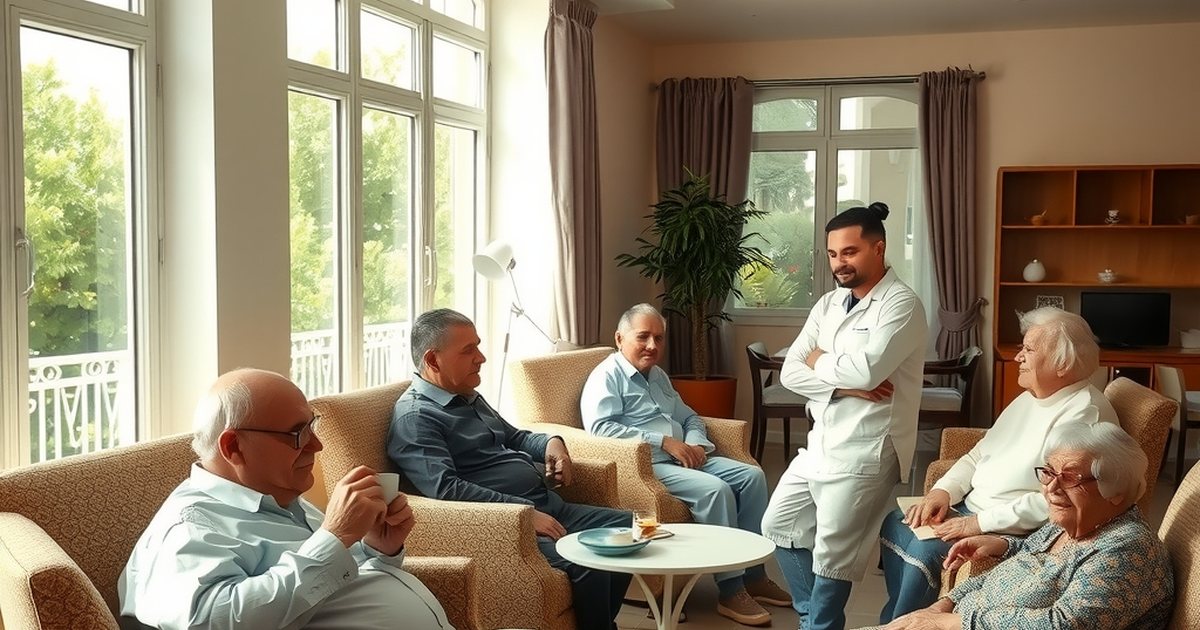
Public homes for older persons (what people call "dar el-ajaza")
They are supervised by the Ministry of National Solidarity, the Family and the Status of Women. In April 2026 the Solidarity sector announced that it supervises 32 institutions specialised in the care of older persons. This number changes over time, so check with the directorate of social action and solidarity in your wilaya.
Recruitment to these institutions follows the rules of the civil service and the posts that are open, so follow their official announcements and the offices of the National Employment Agency (ANEM).
Private establishments for older persons
This is a regulated activity: Executive Decree 19-155 of 30 April 2019 sets the conditions for their creation, organisation, operation and inspection, and Law 10-12 (Article 29) requires prior authorisation from the minister in charge of National Solidarity. The law (Article 35) punishes anyone who runs a care establishment for older persons without authorisation with imprisonment of one to three years and a fine of 50,000 to 500,000 DA.
Practical advice: before accepting a job in a private establishment, ask for its authorisation number. Working in an unauthorised facility leaves you without protection.
Home care
Article 23 of Law 10-12 states that the State works to keep older persons in their family environment or in their own homes through comprehensive care that includes treatment, home help and help with household matters. In December 2025 the Ministry of Solidarity launched the digital platform "Murafaqa" (accompaniment) to provide information and guidance to families caring for an older person at home.
In practice, most home-care opportunities come directly from families, which is why a written contract and registration with social security matter more than anything else (see the section on contracts).
Care home admission requirements in Algeria: what does Law 10-12 say?
Law No. 10-12 of 29 December 2010 on the protection of older persons (Official Gazette No. 79 of 2010) is the reference text. The most important points for anyone working in this field:
- It applies to every person aged 65 or over (Article 2).
- Protection is a duty that falls first on the family, especially descendants (children), and then on the State, local authorities and associations (Articles 3 and 4).
- Placement in a specialised institution is intended mainly for older persons who are destitute or have no family ties, and a person is admitted or remains there only when necessary or when no alternative solution exists (Article 26).
- Anyone with sufficient income contributes to the cost of care, as do the able persons responsible for them (Article 30).
- An older person in difficulty without sufficient resources has the right to social assistance or an allowance of no less than two thirds of the guaranteed national minimum wage (Article 24).
- The State undertakes to provide the institutions, staff and means needed to care for dependent older persons (Article 22), and encourages training and studies in the field of their care (Article 13).
- Anyone who neglects an older person or exposes them to danger is liable to the penalties set out in the Penal Code (Article 33).
- 27 April of each year is the "National Day of the Older Person" (Article 41).
An amendment under study
In March 2026 an initiative to amend Law 10-12 and to criminalise children's abandonment of their elderly parents received preliminary approval and entered the legislative process. We have not verified that it was finally adopted as of October 2026, so check the Official Gazette before relying on it.
Core skills: what do you really need to master?
Good intentions are necessary but not enough. These are the competences families and institutions look for, and what any serious training should cover:
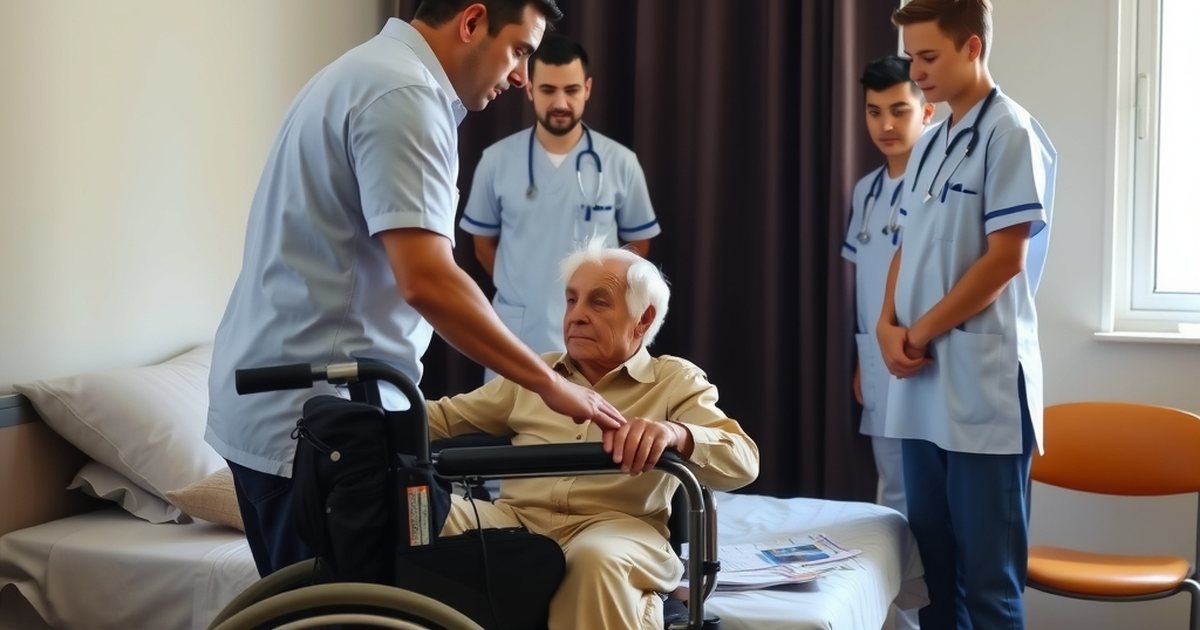
1. Hygiene and infection prevention
Washing hands between each task, caring for the skin of someone who stays in bed, and changing their position regularly. The World Health Organization lists pressure ulcers (bedsores) among the common "geriatric syndromes" in older people, alongside frailty, falls, acute confusion and urinary incontinence.
2. Safe movement and fall prevention
Bed-to-chair transfer techniques, using a walking stick and a walker, and protecting your own back too. At home: removing slippery rugs, lighting corridors at night, and fitting grab handles in the bathroom.
3. Nutrition and hydration
Following the diet set by the doctor (diabetes, blood pressure, difficulty swallowing), cutting food appropriately, and monitoring water intake, especially in summer, because many older people do not feel thirst.
4. Dementia and Alzheimer's basics
According to the World Health Organization, 57 million people worldwide were living with dementia in 2021, with nearly 10 million new cases each year, and Alzheimer's disease accounts for 60 to 70% of cases. The signs often begin with forgetting recent events, misplacing things and confusion in familiar places.
What a care assistant needs: a steady daily routine, short and calm sentences, not arguing with the person about "the truth", and informing the family of any sudden change in behaviour.
5. First aid
Choking on food, falls, loss of consciousness and low blood sugar happen at home before any doctor arrives. Learn first aid from a specialised body: Civil Protection has run the "a first-aider in every family" programme for citizens since 2010, and press reports have described its courses as lasting 21 days and ending with an assessment and a certificate. Ask your nearest unit about current dates.
6. Personal qualities
Patience, honesty, confidentiality about what you see inside people's homes, physical fitness, and the ability to separate empathy from exhaustion: an exhausted carer does not give good care.
Elderly care course: training routes in Algeria
There is no single path. The options actually available differ in length, depth and type of certificate, so choose according to your goal:
- Public vocational training (CFPA centres and INSFP institutes): the specialities on offer change from one intake to the next and from one wilaya to another. We found no single speciality called "care assistant" in the official sources available online, so ask your wilaya's centre directly, at each enrolment intake, about nearby specialities in social and health services.
- First-aid training with Civil Protection or the Algerian Red Crescent: a necessary complement to any route.
- Short specialised courses at private institutions: useful for quickly gaining practical skills, provided the programme is clear and the certificate can be verified.
TKAWEN's "Auxiliaire de Vie" training
Among short courses, TKAWEN offers Auxiliaire de Vie (care assistant) training in person in Algiers, lasting three days according to the programme page, covering five areas: ethics of human care, chronic diseases and Alzheimer's, nutrition and first aid, safe patient transfer, and an introduction to comprehensive geriatric assessment (CGA).
Participants receive a digitally verified certificate through Algeria Certify, which any employer can verify by QR code. Registering on the page costs nothing, and the team then contacts the registrant with details of the course and payment.
A checklist before you enrol on any course
Ask these questions of any provider, including us:
- Is the programme written and detailed, with the topics and hours?
- Does it include hands-on practice in transfers, hygiene and first aid, or only theory?
- Who is the trainer, and what is their field experience in care?
- What type of certificate is it? Can an employer verify it themselves? (Read the guide Authentication and verification of certificates.)
- Does the provider promise guaranteed work or a visa? If it does, that is a warning sign.
Working in a care home in Algeria and employment contracts
Realistic search channels: competitions and announcements by public institutions, the National Employment Agency (ANEM), licensed private establishments, and families directly through personal contacts. You can also follow the job offers published on the TKAWEN jobs page.
What does labour law say about the contract?
Under Article 11 of Law 90-11 of 21 April 1990 on labour relations, a contract is deemed to be concluded for an indefinite period unless otherwise stated in writing. A fixed-term contract (CDD) is allowed only in the cases listed in Article 12, including the temporary replacement of an absent worker or work of a temporary nature, and it must state its duration and reason.
The employer must apply for the new worker's registration with the National Social Insurance Fund (CNAS) within ten days of hiring, and this includes the family that employs you at home as an employer.
A checklist before signing an elderly care contract
- A written contract naming both parties, the place of work (home or institution), the type of contract and, if fixed-term, its duration and reason.
- A description of duties: do they include housework? Care for one person or more?
- Working hours, night shifts and weekly rest.
- The pay, how it is paid and on what date, in writing and not verbally.
- Your registration with CNAS.
- Whom to contact in a medical emergency, and what you are and are not allowed to do.
Why we do not give a salary figure
Because we did not find a reliable, up-to-date source for pay in this profession in Algeria, and pay varies greatly between homes and institutions, between wilayas, and with the number of hours and night work. Treat any fixed figure you see online without a source with caution; the only correct reference is your written contract.
Elderly care in Europe: France as an example, without promises
The need for care workers in Europe is real, but the route to it is legal and long. In France, for example, the title "auxiliaire de vie" is common in job adverts, but employers usually ask for one of these two French qualifications:
The two most requested qualifications
- DEAES (Diplôme d'État d'accompagnant éducatif et social): a State diploma at level 3, governed by Decree 2021-1133 of 30 August 2021 and made up of five skills blocks. An example from a French training centre's programme for the 2026-2027 intake: 546 theory hours, 21 hours of emergency first aid (AFGSU 2) and 840 hours of work placement in the field.
- ADVF (Titre professionnel Assistant de vie aux familles): a level 3 professional title awarded by the French Ministry of Labour (national register RNCP 37715, valid until July 2028), with three blocks: home and laundry upkeep, accompanying a person in their basic daily activities, and childcare at home.
What about your Algerian certificate?
France does not legally recognise a principle of "equivalence of certificates". The ENIC-NARIC France centre issues an "attestation de comparabilité" (comparability statement) that places your foreign qualification against the French system; it is not an equivalence. In unregulated professions you can present it to the employer, but the decision remains theirs.
As for residence and work, for Algerians they are governed mainly by the Franco-Algerian Agreement of 27 December 1968 and its amendments, and require a work contract and official procedures. Good command of French is a practical requirement in every case.
Signs of a scam
- "Guaranteed" work in Europe in exchange for a sum of money.
- A "guaranteed" visa as soon as you get a course certificate.
- A foreign work contract that arrives before any interview or verification of your certificate and language.
Quick comparison: where to start?
Each work setting has its advantages and its requirements:
- Care at home: flexibility and a direct relationship with the family, but the work is solitary and you must insist yourself on a written contract and social security registration.
- Public home for older persons: a team and a clear administrative framework, but posts are limited and go through the official recruitment channels.
- Licensed private establishment: organisation, shifts and more opportunities in the big cities, provided you check the authorisation.
- Working abroad: high demand, but it needs the host country's qualification or an equivalence route, good language skills and legal residence procedures, and it takes time.
Common mistakes beginners make
- Working without a written contract or social security registration "because the family is kind".
- Giving medication or adjusting a dose without a prescription, or doing nursing tasks you are not trained for.
- Lifting the older person with your back instead of your legs, so you are injured and they fall.
- Ignoring small signs: refusing food, new confusion, redness of the skin that does not go away.
- Paying money to someone who promises a work contract abroad.
- Choosing a course with no written programme, no hands-on practice and no certificate that can be verified.
Auxiliaire de Vie (care assistant) training
Three days in person in Algiers: care ethics, Alzheimer's and chronic diseases, nutrition and first aid, and safe transfers, with a digitally verified certificate that can be checked by QR code. Register your interest and we will get in touch with the details.
See the programme and register →Frequently asked questions
What does auxiliaire de vie mean in Arabic?
It means "life assistant", and is also expressed as "elderly companion" or "older-person care provider". It is the person who helps an older or dependent person with the activities of daily life such as hygiene, getting around and eating, without doing nursing tasks.
What are the admission requirements for a care home in Algeria?
Under Article 26 of Law 10-12, placement in a specialised institution is intended mainly for older persons (65 or over) who are destitute or have no family ties, and happens only when necessary or when no alternative solution exists. Anyone with sufficient income contributes to the costs. The file is examined through the social action services of the wilaya.
How do I work in a care home in Algeria?
Follow the official recruitment announcements of public institutions and the offices of the National Employment Agency (ANEM), or apply to a private establishment licensed by the Ministry of National Solidarity. Hands-on training in care and first aid strengthens your application, and you can follow offers at tkawen.com/jobs.
What should an elderly care employment contract include?
The type of contract and, if fixed-term, its duration and reason (Article 12 of Law 90-11), the place of work, the duties in detail, working hours, night shifts and rest, the pay and the date it is paid, and registration with CNAS, which must be requested within ten days of hiring.
Is there an elderly care certificate or diploma in Algeria?
There are several routes: public vocational training offers, which differ by wilaya and intake, first-aid courses, and short courses at private institutions. Before enrolling, ask for the detailed programme, the hands-on practice, the type of certificate and whether it can be verified.
How long does an elderly care course last?
It varies greatly: from short courses of a few days to gain basic skills, to long programmes. For comparison, the French DEAES requires more than 1,400 hours of theory and field placement. Choose the length according to your goal: quick local work or a long professional path.
Is a short course enough to work in France?
No. Employers in France usually ask for a French qualification such as the DEAES or ADVF, a good level of French, and legal residence and a work permit. A short course helps with skills and local work, but does not give the right to work abroad.
What is the difference between a care assistant and a care aide?
A care assistant accompanies the person in the activities of daily life and the social side. A care aide (aide-soignant) works on the care side under the supervision of the nurse. In France, for example, the DEAES can later be a stepping stone towards the aide-soignant diploma (DEAS).