Certificate Authentication and Verification in Algeria: The Complete Guide 2026
To authenticate an Algerian certificate for use abroad, since 9 July 2026 you need the "apostille" if the destination country is a party to the Hague Convention, and you request it through the National Apostille Platform after the issuing body has validated the document; for countries that are not parties or that have objected, consular legalisation through the Ministry of Foreign Affairs remains. To verify a training certificate inside Algeria, it is often enough to scan its QR code or enter its code on the verification page of the issuing body. This guide explains each route with its steps, fees and official sources: university degrees, vocational training certificates, the baccalaureate, equivalence, then digital verification and how to spot a forged certificate.
What does "authenticating a certificate" mean? Three different operations
People use the word "authentication" for three operations that have nothing to do with one another, and confusing them is the biggest cause of lost time. First decide which one you need:
- Legalisation for use abroad: proving that the signature and seal on the certificate really come from a competent Algerian authority. Today this is done by apostille or by consular legalisation, depending on the destination country.
- Equivalence: an administrative decision that sets the value of a foreign certificate inside Algeria (or the value of an Algerian certificate in another country). It does not prove the signature is genuine, but the academic level.
- Verification of authenticity: the question an employer or university asks, "is this certificate genuine and issued by this body?", answered by checking the issuing body's register, on paper or digitally.
What the apostille proves and what it does not
Under Article 3 of the 1961 Hague Convention and as the National Apostille Platform explains, the apostille certifies the authenticity of the signature, the capacity of the signatory and the identity of the seal, but not the content of the document. That is, it does not say the certificate is equivalent to one from the destination country, and it does not replace equivalence where that is required.
The apostille in Algeria: what changed since 9 July 2026
Algeria deposited its instrument of accession to the Hague Convention of 5 October 1961 (abolishing the requirement of legalisation for foreign public documents) on 5 November 2025, and the Convention entered into force for it on 9 July 2026, as shown in the status table of the Convention at the Hague Conference. On the same date the National Apostille Platform opened for applications.
In practice: an Algerian public document sent to a state party no longer goes through the chain "ministry, then Foreign Affairs, then consulate", but carries a single stamp, the apostille, affixed by the competent authority in the issuing sector.

Sectors covered and competent authorities
Algeria set five sectors in the first phase, each with an authority competent to affix the apostille, according to the platform's official guide:
- Higher education: the Directorate of Diplomas, Equivalences and University Institutions, for university degrees.
- National education: central departments, and institutions including the National Office for Examinations and Competitions (ONEC) and the education directorates of the wilayas.
- Vocational training: the Director of Guidance, Examinations and Diplomas centrally, and the vocational training directorates of the wilayas locally.
- Interior: civil status documents through the administrative districts of the wilaya of Algiers and the daira seats in the other wilayas, and certificates from training institutions under the sector centrally.
- Justice: the public prosecutors' offices at the judicial councils, for judicial documents.
The five steps to obtain the apostille
The procedure is common to all sectors, as presented by the National Apostille Platform:
- Obtain the original signed and sealed document from the issuing institution (university, training centre, municipality...).
- Have it pre-validated by the supervisory authority if required, which varies by sector (for example the university presidency for university degrees).
- Create an account on the platform and submit the application, then file the dossier with the competent authority: the original, a copy and the proof of payment of the fee.
- Pay the stamp duty: DZD 1500 per apostille, at the tax collector or the post office collector, and a secure stamp is issued to you immediately.
- The competent authority checks the document, affixes the apostille and hands it back to you; the time varies by sector.
Important warning: Germany, Austria and Greece
Article 12 of the Convention allows any state party to object to the accession of a new state, in which case the Convention does not apply between them. According to the Dutch treaty database (the Netherlands being the depositary state), Germany objected to Algeria's accession on 6 March 2026, Austria on 20 April 2026 and Greece on 7 May 2026. This means that the apostille is currently not sufficient for a document sent to these countries, for which consular legalisation remains.
The list may change through withdrawals or new objections, so check the status table of the Convention at the Hague Conference before you start.
Authenticating university degrees in Algeria step by step
The route is decided by one question: is the destination country a party to the Hague Convention without an objection to Algeria?
To a state party (France, Spain, Canada, Italy...)
Collect the final degree and the transcripts from your university, then follow the apostille steps above. The competent authority is the ministry's Directorate of Diplomas and Equivalences and the university institutions themselves. Some universities have opened dedicated offices; for example, University of Algiers 1 announced on 21 July 2026 the opening of an apostille office that works by online appointment: uploading the documents, then an appointment to complete the procedure, then affixing the apostille and handing over the file, covering all documents the university issues and not just the final degree.
Before travelling, ask your university's diplomas office: does it have an apostille office, or must you go to the ministry?
To a non-party state or one that has objected
Here the traditional route remains: authentication of the degree with the higher education sector, then legalisation at the Ministry of Foreign Affairs, then usually at the consulate of the destination country. University authentication goes through the authentication platform in PROGRES (Authentification des diplômes), by creating an account and uploading the documents as PDF.
To reduce trips to the capital, the Ministry of Foreign Affairs and Algérie Poste signed a framework agreement on 16 July 2025 that allows documents intended for use abroad to be lodged at post offices and tracked until they return legalised.
The university degree itself carries a QR code
The Ministry of Higher Education ordered in June 2024, as reported by Algérie 360, that final degrees be issued in place of provisional pass certificates, and that a QR code be mandatory on every degree for remote verification. If your degree is recent, this code is the first thing an employer will scan.
Authenticating a vocational training certificate and the baccalaureate
Vocational training certificates (vocational training and education sector)
Certificates from public vocational training institutions have been part of the apostille system since 9 July 2026. The competent authority is the vocational training directorate in your wilaya locally, and the director in charge of guidance, examinations and diplomas centrally. Start from the institution where you trained to obtain the original, then the wilaya directorate.
What about certificates from private training schools?
The apostille applies to public documents only and is not affixed to private documents, as the National Platform states. So a certificate issued by a company or training firm in its private capacity does not enter this route directly. If you need the certificate for a file abroad, ask your wilaya's vocational training directorate about the status of the institution and its certificate before enrolling.
The baccalaureate (National Office for Examinations and Competitions)
The baccalaureate belongs to the national education sector, and the National Office for Examinations and Competitions (ONEC) is listed among the competent apostille authorities in this sector, as the Ministry of Education announced when it adopted the system for all public documents issued by its central administration, its directorates and its institutions. First make sure you hold the final certificate and not the provisional pass certificate.
Equivalence: when you need it and who grants it
Equivalence is not requested to verify that a certificate is genuine, but to determine its value. Two common cases:
- A foreign university degree you want to use in Algeria: the application is submitted exclusively through the digital platform of the Ministry of Higher Education and is governed by Executive Decree No. 18-95 of 19 March 2018. According to the ministry's announcement, the decision is issued within 8 days for degrees on the reference list, and within 30 days at most for those that need expert review, with the possibility of appeal within 30 days.
- An Algerian degree you want to use abroad: equivalence is granted by the competent body in the destination country, not by Algeria. You will often be asked for a certificate carrying an apostille or consular legalisation, so start with the legalisation, then the equivalence.
Quick comparison: which procedure fits your case?
Choose the line that describes your situation:
- University degree to France, Spain or Canada: apostille through the National Platform after the university's validation. No consular legalisation.
- University degree to Germany, Austria or Greece: traditional legalisation (sector, then Foreign Affairs, then consulate), because these countries objected to Algeria's accession.
- Certificate to a country that is not a party to the Convention: the same traditional legalisation.
- Foreign certificate for use in Algeria: equivalence through the Ministry of Higher Education's platform.
- Employer who wants to check a training certificate: digital verification by QR code or code with the issuing body, free and instant if the certificate is digital.
Digital verification of training certificates: how does it work?
The apostille is a solution for public documents sent abroad. In the everyday job market inside Algeria, the question is simpler: was this certificate really issued by the institution whose name is written on it? That is where digital verification comes in.
A QR code + a register at the issuing body
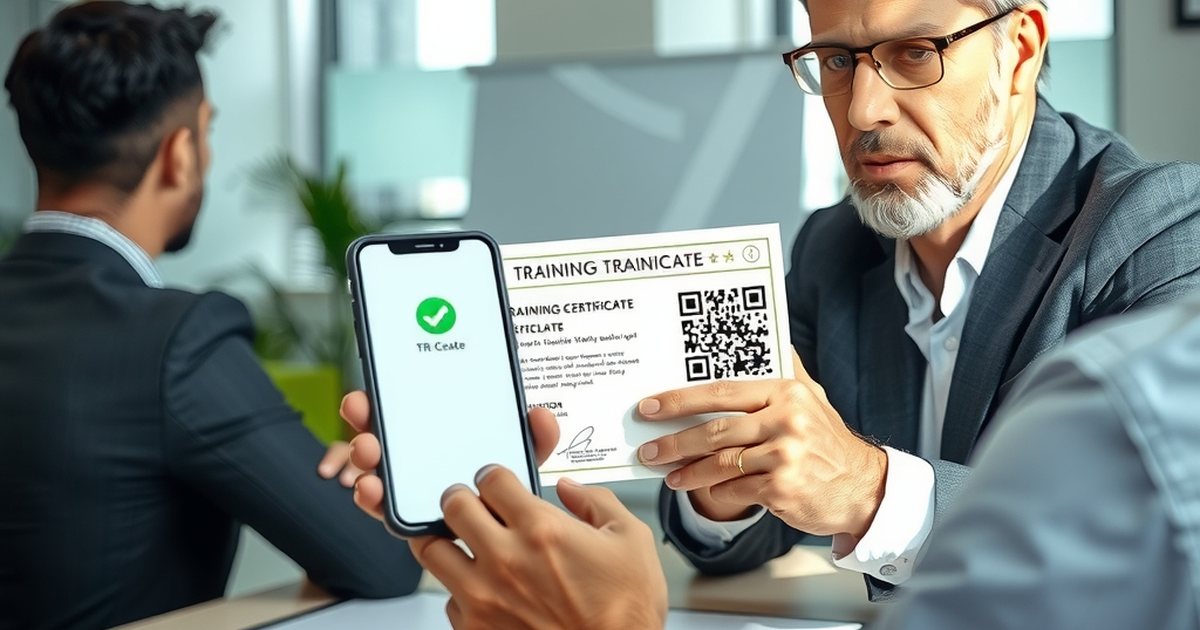
A digital certificate carries a unique code and a QR code that leads to a page on the issuing body's website. The value is not in the paper but in the register: the page shows the holder's name, the programme, the issuing body, the date and the status (valid, or revoked). If the paper does not match the register, or there is no register, the paper is worth nothing, however well made it looks.
The difference from a paper certificate
A paper certificate is checked by looking at the seal and signature, which is easy to imitate. A digital certificate is checked by going back to the source, so a copy that imitates only the appearance does not pass verification because it has no matching record.
Verify a certificate in under a minute
- Scan the QR code with your phone camera, or copy the certificate code printed on it.
- Make sure the link opens on the issuing body's real domain, not on a shortened link or a site with a similar name.
- Compare the first name, surname, programme and date on the page with the paper, letter by letter.
- Pay attention to the certificate's status: "revoked" or "expired" means it is no longer valid, even if it was genuine on the day it was issued.
- If there is no code and no verification page, write to the issuing body directly using its official number, not the number printed on the certificate.
How to spot a forged certificate: common mistakes
Forgery and use of forged documents are offences in Algeria, governed since 2024 by a standalone law, Law No. 24-02 of 26 February 2024 on combating forgery and the use of forged documents. But most mistakes come not from the forger but from the person verifying:
- Settling for a photocopy or a photo on a phone: always ask for the code or the original.
- Scanning a QR code without looking at the link: a QR code can lead to any site, and what matters is the domain it opens on.
- Trusting the phone number printed on the certificate to confirm it: call the institution's official number.
- Confusing "the certificate is in the register" with "the certificate is recognised by the State": the former proves only the source.
- Ignoring dates: a training length that does not fit the issue date, or a certificate issued before the institution was founded, are signs worth questioning.
- Forgetting the revocation status: a certificate withdrawn later still looks intact on paper.
Candidly: what digital verification proves and what it does not
Digital verification answers one question precisely: who issued this certificate, to whom, when, and is it still valid. It does not answer the question of official recognition. Recognition of vocational training certificates goes through the vocational training and education sector, recognition of university degrees through the higher education sector, and acceptance abroad through the apostille or consular legalisation and then equivalence.
That is why our advice to any trainee is: if you need a certificate for an immigration file or a public-sector job, ask beforehand about the certificate's status with the sector concerned. And if you need quick proof of competence in front of a private employer, a digitally verifiable certificate spares them doubt and spares you the wait.
Algeria Certify: free verification of any certificate issued through it
With this in mind TKAWEN built the Algeria Certify platform: every certificate issued through it carries a code and a QR code, and anyone can verify it free and instantly, with no account or subscription. The page shows the holder, the programme, the issuing body, the issue date and the certificate's status, and verification is also possible through tkawen.com/verify.
TKAWEN certificates are digitally verified (QR code): any employer can confirm that they were really issued by us and to that specific person. They do not replace the government certificate where the law requires it.
For training organisations: issue verifiable certificates
If you are a training centre or an independent trainer and want to protect your name from impersonated certificates, you can issue certificates verifiable online through Algeria Certify. And if you want a complete online academy under your own name, TKAWEN OS automatically issues the digitally signed certificate with a QR code when the learner completes the course. For trainers: the trainers directory lists verified profiles that any organisation can consult.
Verify a certificate now, or issue verifiable certificates
Enter the certificate code or scan the QR code to see its holder, issuer and status instantly, free and without an account. For training organisations: certificates verifiable online that protect your name.
Verify a certificate →Frequently asked questions
Is Algeria a member of the Hague Apostille Convention?
Yes. Algeria acceded to the Convention of 5 October 1961 by depositing its instrument of accession on 5 November 2025, and it entered into force for Algeria on 9 July 2026. But it does not apply with the states that objected to the accession, which, as of October 2026, are Germany, Austria and Greece.
How do I authenticate my university degree for use abroad?
If the country is a party to the Convention without an objection: collect the original from the university, have it validated by the university presidency if required, then submit the apostille application via apostille.gov.dz and pay the stamp duty. If it is not a party: authentication through the PROGRES platform, then the Ministry of Foreign Affairs' legalisation, then the consulate's.
How much does the apostille cost in Algeria?
The stamp duty is DZD 1500 per apostille, paid at the tax collector or the post office collector against a secure stamp. Replacing a lost, damaged or stolen stamp carries a reduced stamp duty of DZD 600, according to the General Directorate of Taxes.
How do I authenticate a vocational training certificate?
Certificates from public vocational training institutions fall within the apostille system. Collect the original from your institution, then go to the vocational training directorate of your wilaya, the competent authority locally, after submitting the application on the National Platform.
Does the apostille replace degree equivalence?
No. The apostille only certifies the authenticity of the signature and seal and the capacity of the signatory, and does not assess the content of the certificate. Equivalence is a separate decision issued by the competent body in the country where the certificate will be used.
How do I verify a training certificate by QR code?
Scan the code and make sure the page opens on the issuing body's real site, then compare the name, programme, date and status with the paper. For certificates issued through Algeria Certify, verification is free and requires no account at algeriacertify.com/verify.
Is a digitally verified certificate recognised by the State?
Digital verification proves who issued the certificate, to whom and when, and does not mean government recognition. Official recognition goes through the relevant ministerial sector, and acceptance abroad through the apostille or consular legalisation.
What should I do if the destination country is Germany?
Germany objected to Algeria's accession on 6 March 2026, so the apostille is currently not sufficient. Follow the traditional route: sector authentication, then the Ministry of Foreign Affairs' legalisation, then legalisation by the German embassy or consulate, and check for updates in the Convention's status table at the Hague Conference.