What Is MCP (Model Context Protocol)? The Complete Illustrated Guide
The Model Context Protocol (MCP) is the most important open standard to appear in artificial intelligence in years. Anthropic launched it in November 2024, and in less than a year it was adopted by OpenAI, Google and Microsoft before its governance moved to the Linux Foundation. This guide explains — with diagrams — what MCP is, the problem it solves, how it works in detail, who supports it, and why it matters to anyone building a digital product.

MCP in a nutshell
MCP stands for Model Context Protocol. It is a free, open standard that lets AI applications — such as Claude or ChatGPT — connect to external tools and data sources in a uniform way. Anthropic launched it on 25 November 2024 as an open-source project, with development kits for Python and TypeScript.
The best-known analogy: MCP is “USB-C for AI”. Just as the USB-C port unified how every device connects with a single cable, MCP unifies how any AI model connects to any tool through a single protocol. The full official reference is available at modelcontextprotocol.io.
- A free, open standard that no single company owns.
- Launched by Anthropic in November 2024.
- The idea: “USB-C for AI” — one connector that links everyone.
The problem it solves: the M×N mess
Before MCP, connecting M AI applications to N tools required writing custom connectors for every pair — M×N separate integrations. Ten apps and ten tools meant a hundred fragile integrations. Engineers call this the “M×N problem”, an explosion that turns maintenance into a nightmare and slows innovation.
MCP turns M×N into M+N: each app only has to implement the protocol once, and each tool only has to expose itself as an MCP server once, for everyone to talk to each other. One standard integration instead of a hundred custom connectors.
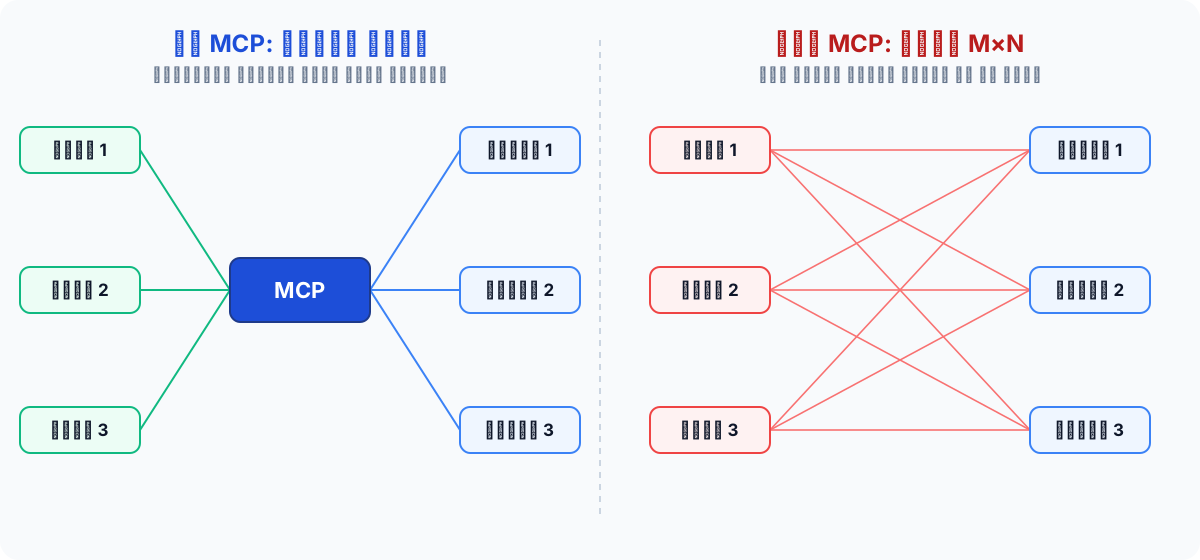
- The “M×N problem”: every app-tool pair needs its own connector.
- MCP reduces it to M+N: each side implements the protocol once.
- The result: simpler integration, less maintenance, faster innovation.
How does MCP work? The architecture
MCP is built on a client-server architecture. The AI application (the host) opens a client session that connects to an MCP server over JSON-RPC 2.0 — lightweight, two-way messages (request, response, notification) that suit the way models call tools dynamically.
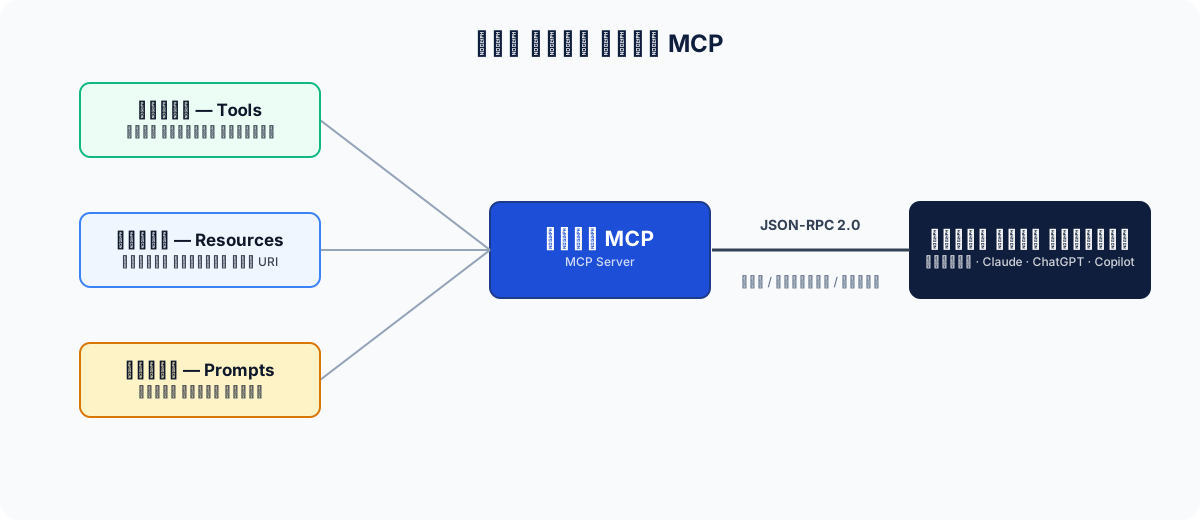
Tools
Functions the model executes, each with a name, parameters, an output schema and a description — such as “create an order” or “verify a certificate”. They are what make the model able to act, not just talk.
Resources
Read-only data, addressed by URIs, loaded as context into the session — such as a file or a record. The model reads them to understand before it acts.
Prompts
Ready-made message templates exposed by the server; called with arguments, they return messages the client sends to the model to carry out a specific task. The model discovers these three capabilities dynamically and invokes them as needed.
Who supports MCP? Rapid global adoption
What started as an internal experiment became an industry standard in less than a year.
OpenAI, Google and Microsoft
In March 2025 OpenAI officially adopted it and added it to ChatGPT, followed by Google DeepMind, Microsoft — which developed an official C# development kit — and AWS. The details are documented on the MCP page on Wikipedia.
On to the Linux Foundation
By the end of 2025, Anthropic donated the protocol to the Linux Foundation, sponsored by OpenAI, Google and Microsoft, so it stopped being “Anthropic’s protocol” and became infrastructure for the whole industry. Published figures point to more than 97 million monthly SDK downloads and more than 10,000 active MCP servers, according to the first-year review on the official MCP blog.
Why MCP matters if you are building a product
MCP isn’t a technical detail for research labs. Anyone building a digital product today has an opportunity: expose the product’s capabilities as MCP tools and become reachable by every AI assistant in the world. Your customer might use your service from inside Claude or ChatGPT without ever opening your website — an entirely new distribution channel.
We explained this opportunity for startups in detail in why startups need an MCP server, and how we applied it in Algeria in MCP server in Algeria.
Sources & references
Anthropic’s official announcement: Introducing the Model Context Protocol.
Official site and documentation: modelcontextprotocol.io — and an overview of the architecture.
A comprehensive encyclopedic article: Model Context Protocol — Wikipedia.
Algerian MCP servers by TKAWEN
We’re not watching the revolution from the sidelines: TKAWEN builds real MCP servers for the Algerian ecosystem. See how we apply the global standard locally.
Explore the ecosystem →Frequently asked questions
What does MCP stand for?
MCP stands for Model Context Protocol: an open standard that connects AI applications to tools and data sources in a uniform way. Anthropic launched it in November 2024.
Is MCP free and open?
Yes. MCP is a free, open-source standard whose governance has moved to the Linux Foundation, sponsored by Anthropic, OpenAI, Google and Microsoft, so it no longer belongs to a single company.
What is the difference between an MCP server and a regular API?
An API is designed for developers to write code against. An MCP server exposes its capabilities in a way an AI model understands directly (tools, resources and prompts), so the model calls them itself, over a unified protocol that works with any compatible client.
Who supports MCP today?
Anthropic (Claude), OpenAI (ChatGPT), Google DeepMind, Microsoft (Copilot) and AWS, along with thousands of active servers and hundreds of compatible clients.