Forklift Driving Licence ("Clark") in Algeria: What Actually Exists and How to Qualify
In the published texts we reviewed, Algeria has no national forklift "driving licence" issued by an administration in the way an ordinary driving licence is. What is actually required is training proven by a certificate, medical fitness decided by the occupational physician, and then authorisation by the employer, whom Law 88-07 obliges to train workers on the hazards of their posts. This guide explains precisely what Algerian law says, how it differs from the French CACES, the training routes available, the types of forklift, the daily inspection checklist, the most common accidents and how to avoid them, and then the jobs this skill opens up.
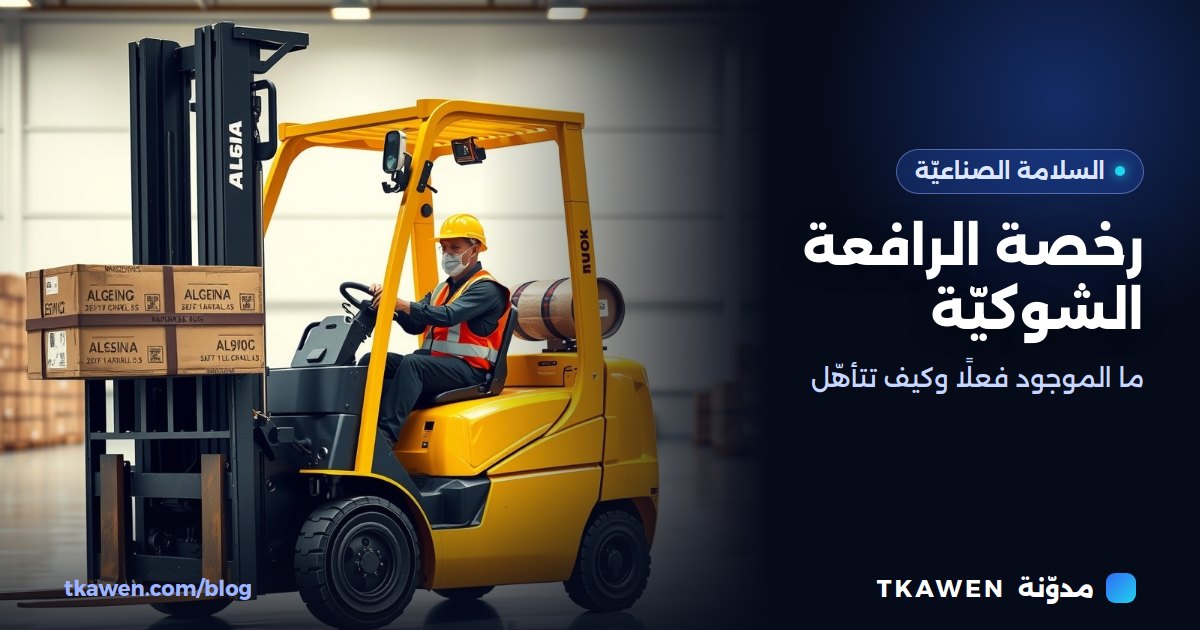
Is there an official forklift driving licence in Algeria?
When people type "forklift driving licence" or "forklift licence", they usually mean the document the employer asks for before handing you the controls. That document is not a driving licence of a special category but proof of qualification. In the published Algerian texts we found no provision creating a national administrative licence specific to the forklift driver (cariste).
The framework that governs the matter is the law on occupational health, safety and medicine, Law No. 88-07 of 26 January 1988. Its Article 3 obliges the employing body to ensure workers' health protection and safety, and its Article 19 makes education, information and training on occupational hazards a duty of the employing body. In other words, legal responsibility for qualifying the driver falls first on the employer, which is why it asks you for written proof.
What does the "licence" consist of in practice in the Algerian market?
In practice, employers ask for a set of documents that stands in for the licence:
- A forklift driving training certificate: either a certificate from public or private vocational training, or a short-course certificate from a training institution.
- A medical fitness certificate for the post, issued by the occupational physician on hiring.
- Experience proven by work certificates, which are very often requested in job offers.
- Inside the company: a written assignment or driving authorisation specifying the machine and the site, a good practice common in companies that apply international standards, although we found no Algerian text that prescribes its form.
What Algerian law says: training, occupational medicine and machine inspection
Three essential texts are enough to understand the employer's duties and the driver's rights. None of them names the forklift as a licence, but they apply to it as lifting and handling equipment.
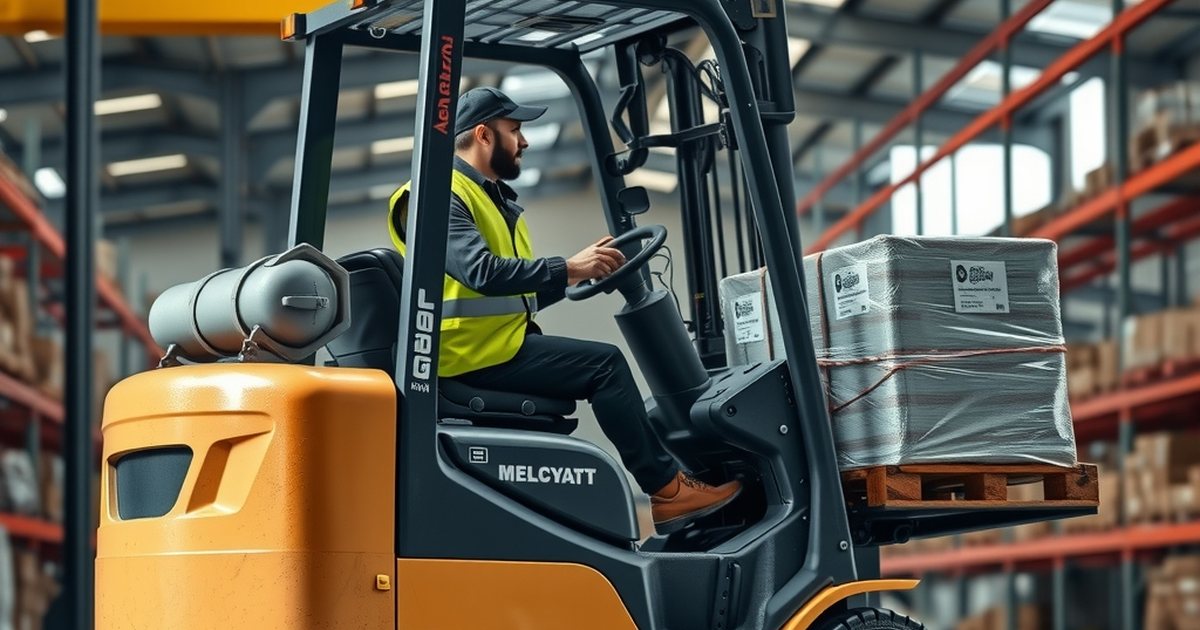
Law 88-07 (1988): training and the medical examination
Besides Articles 3 and 19, Article 17 makes workers subject to medical examinations on hiring and periodic examinations, and Article 13 makes occupational medicine an obligation of the employing body. This means the medical examination is not a condition imposed by the training institution but a legal duty borne by the employer.
Executive Decree 91-05 (1991): machines and lifting appliances
Executive Decree No. 91-05 of 19 January 1991 sets the general protection rules applicable to health and safety in workplaces. According to a legal study published on the Algerian Scientific Journals Platform (ASJP), its Articles 63 to 65 require equipment and machinery to undergo periodic inspection and maintenance, including lifting appliances and loading and unloading equipment, carried out by qualified staff or technical inspection bodies.
Executive Decree 93-120 (1993): occupational medicine
This decree of 15 May 1993 regulates occupational medicine. According to the same study, the hiring examination includes a full clinical examination to confirm that the worker is medically fit for the post; the examination is repeated on transfer to a new post, and the worker undergoes a periodic examination at least once a year. So you may be asked for a new examination if you move from another post to driving the forklift within the same company.
The French CACES compared with Algerian practice
The name CACES appears often in Algerian training adverts and job offers, so it is useful to know what it is. In France, the Labour Code (Articles R4323-55 and R4323-56) requires suitable training for drivers of handling equipment, and a "driving authorisation" (autorisation de conduite) issued by the employer under the order of 2 December 1998. CACES R489 is a certificate of competence awarded after tests run by an approved tester in France, valid for five years; it is a way of proving competence before the employer grants the authorisation, not a State licence.
In short: CACES is a specifically French system and has no legal status in Algeria. But its logic is close to what Algerian law asks for: training, then assessment, then medical fitness, then authorisation by the employer.
Quick comparison
- Source of the obligation: in France the Labour Code and the order of 2 December 1998. In Algeria Law 88-07 and its implementing texts, with no forklift-specific text that we found.
- Proof of competence: in France CACES R489, valid for five years. In Algeria a vocational training certificate or a short-course certificate.
- Who allows driving: in both cases the employer.
- Medical fitness: required in both cases through occupational medicine.
- Renewal: in France CACES is renewed every five years. In Algeria we found no legal period of validity; the best practice is refresher training when the machine changes or after an accident.
How to qualify to drive a forklift in Algeria: the three routes
Training in Algeria is spread across three routes, and you choose among them according to your time and your goal:
1. Certificate-based vocational training
Vocational training in Algeria is built on five qualification levels: level 1, specialised worker, with the CFPS certificate; level 2, skilled worker, with the certificate of professional competence CAP; then the CMP, the BT and the higher technician certificate. Vocational training and apprenticeship centres (CFPA) provide initial training at levels 1 to 4. Some private institutions in Algeria advertise a "professional competence certificate as forklift operator" course lasting 12 months. Before enrolling on any certificate-based course, make sure the institution is accredited by the vocational training sector and that the speciality is listed in the nomenclature of specialities.
2. Short hands-on training
This is the route in greatest demand for people who want to work quickly or who already drive without a certificate. It lasts days, not months, and combines a short theory part (balance, load, traffic rules) with practice on the machine, ending with an assessment and a training certificate. The value of this certificate in the market depends on how serious the assessment is and on the employer's ability to verify it.
3. In-company training
Many companies organise the training of their drivers on their own site and machines, which is closest to the spirit of Article 19 of Law 88-07: training on the hazards of the post itself. It is usually completed by a written assignment specifying the machine the driver is allowed to use.
Practical conditions before any training
- Age: we found no Algerian text specific to the forklift, but European training programmes require 18, and most employers ask for it.
- Medical fitness: eyesight, hearing and reflexes compatible with driving, decided by the occupational physician.
- Being able to read the load plate and the written instructions on the machine.
- Readiness for real practice on the machine: theory-only or online training alone is not enough.
What should a good training programme include?
A useful reference here is the American standard OSHA 29 CFR 1910.178, because it is detailed: it requires training to combine classroom instruction, hands-on practice under the supervision of a qualified person, and an evaluation of the driver's performance in the workplace, with an evaluation of each driver at least once every three years. Judge any course against these three elements.
- The machine's operating instructions and warnings, and how it differs from a car.
- Load capacity, load centre and the stability of the machine.
- The pre-use inspection, and battery charging or refuelling.
- Driving in aisles, on ramps and on slippery floors, and near pedestrians.
- A practical assessment that ends in a clear decision: pass or fail.
The types of forklift you will come across
The international standard ISO 3691-1, on safety requirements for the manufacture of self-propelled industrial trucks, covers several types. The most important in the Algerian market:
- Counterbalance forklift (front-loading): the most widespread, running on diesel, LPG or electricity, used in factories, ports and warehouses.
- Reach truck (retractable mast): for narrow aisles and high racking in distribution warehouses.
- Pallet stacker (gerbeur): for lifting pallets to medium heights.
- Manual or electric pallet truck (transpalette): for moving pallets on the floor.
- Rough-terrain forklift (tout-terrain): for building sites and unpaved ground.
- Telescopic handler (telescopic boom): designed under another part of the standard, and needing training specific to it.
Why does the type matter?
Because training on one type does not automatically qualify you for another. Driving a counterbalance forklift differs from driving a reach truck in the driver's position, the steering and the stability. Ask for your certificate to state the type of machine you trained on.
The stability triangle and the load plate: the heart of safety
A counterbalance forklift stands on three points of support: the two front wheels and the pivot point of the rear axle. These points form the "stability triangle". As long as the combined centre of gravity of the machine and load stays inside the triangle, the machine will not tip over. When you raise the load, move it away from the mast or turn quickly, the centre of gravity moves towards the edge of the triangle.
The load plate fixed to the machine gives three figures that must be respected together: the maximum load, the load centre and the lifting height. Changing the load centre, that is, moving it away from the back of the forks, changes the permitted load.
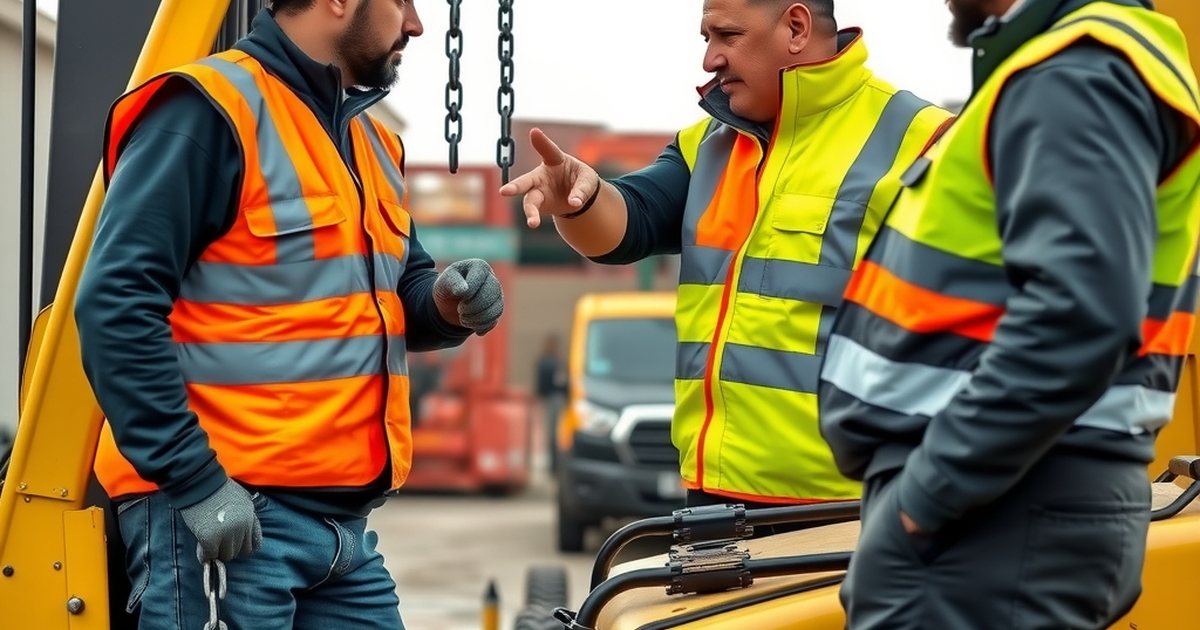
Basic driving rules
- Carry only a stable, well-arranged load, within the capacity rated for the machine.
- Place the heaviest load against the back of the forks, and push the forks under the load as far as they will go.
- Drive at a speed that lets you stop safely, and slow down on wet and slippery floors.
- If the load blocks your view ahead, drive in reverse with the load behind you.
- On slopes steeper than 10%, a loaded machine is driven with the load on the uphill side, the load tilted back and raised only as much as necessary.
- No one stands under raised forks, empty or loaded, and no one rides on the machine.
- When leaving the machine: lower the forks fully, put the controls in neutral, switch off the engine and apply the brake.
The daily pre-start inspection checklist
The OSHA standard requires the truck to be examined before being put into service, at least once a day, and after each shift if it runs around the clock, and bars its use if a defect affects its safety. This is a practical list you can print and hang near the machine:
With the engine off
- Forks: no cracks or bending, and their locking in place.
- Mast and chains: no visible wear or slack.
- Wheels and tyres: pressure or wear, and no cuts.
- Leaks of hydraulic oil, fuel or battery fluid under the machine.
- Fuel level or battery charge, and the condition of the gas cylinder and its connection.
- Load plate present and legible, seat belt and overhead guard intact.
With the engine running
- Brakes and parking brake.
- Steering without unusual play.
- Lifting, lowering and tilting in smooth motion.
- Horn, lights and reversing alarm if fitted.
- Any defect is reported immediately, and the machine is not used until it is repaired.
Common accidents and how to avoid them
The UK Health and Safety Executive (HSE) identifies the causes of vehicle overturns in workplaces, including: steep slopes, slippery floors, soft or uneven ground, edges and kerbs, overloaded or unbalanced loads, speed especially on bends, and carrying a load at a dangerous height.
The five most common hazards
- Side or forward overturn: caused by turning quickly or by a raised load while driving. Prevention: drive with the forks low and slow down before the bend.
- Running over or striking pedestrians: in aisles and at junctions. Prevention: separate pedestrian walkways, and stopping and sounding the horn at junctions with blocked visibility.
- Falling load: an unstable load or one raised higher than necessary. Prevention: a well-arranged, secured load, and the mast tilted back.
- Falling from a loading dock. Prevention: a safe distance from the dock edge, and securing the lorry and the dock leveller before driving on.
- Being trapped between the machine and an obstacle. Prevention: keep arms and legs inside the machine's outline.
If the forklift starts to tip over
Never jump. HSE advises the driver to brace their back against the seat and grip a fixed part of the cab firmly; training references add: brace your feet and lean your body away from the direction of the overturn. And remember that the overhead guard protects you only if you are wearing your seat belt.
Common mistakes among new drivers
- Raising the load and then driving with it high.
- Estimating weight by eye instead of reading it from the parcel label or the invoice.
- Skipping the daily inspection because "the machine worked yesterday".
- Carrying a colleague on the forks or using the platform as a lift.
- Leaving the machine with the forks raised or the engine running.
The jobs that forklift driving opens up
"Cariste" offers are posted on Algerian recruitment platforms in warehouses, logistics companies, industry and distribution. The sectors in greatest demand:
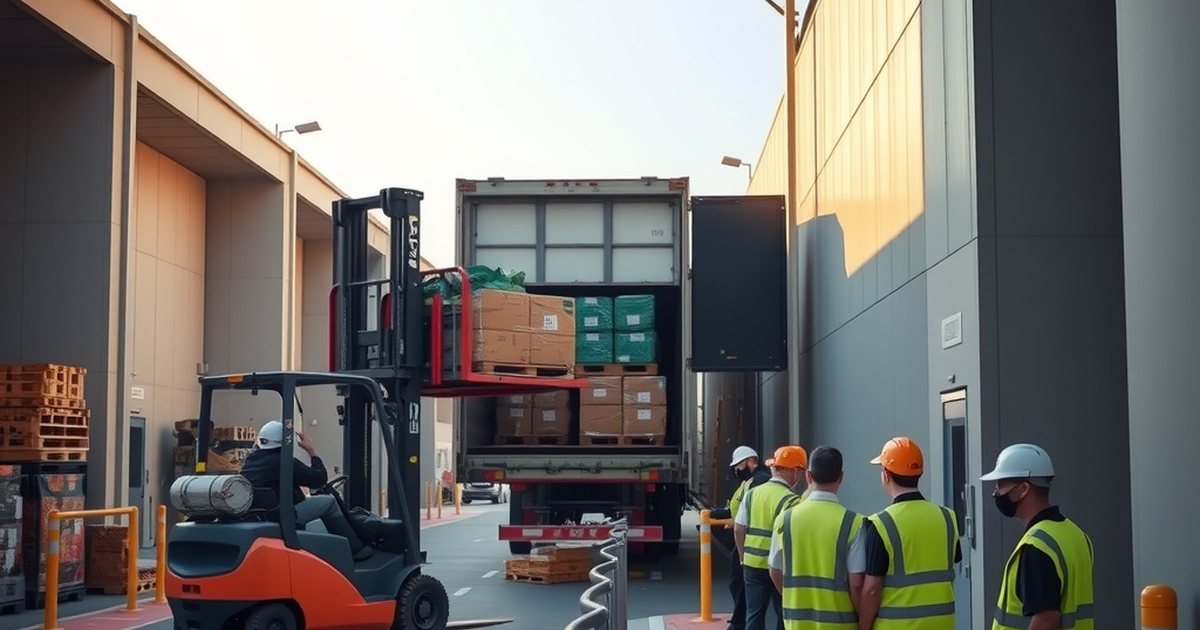
- Warehouses, distribution centres and e-commerce.
- Factories: food and beverages, building materials, plastics and packaging.
- Ports and dry logistics zones.
- Building materials and large worksites, where the rough-terrain forklift is useful.
- Career progression: from driver to storekeeper and then warehouse manager, especially with training in inventory management.
How to strengthen your profile with an employer
Three things make the difference: a certificate stating the type of machine, the length of the training and the result of the assessment, experience that can be verified, and a certificate whose authenticity the employer can check in a minute. Paper certificates that cannot be verified are rejected or treated with caution, which is why digitally verified certificates with a QR code, which can be checked on Algeria Certify, are spreading. You can also present your profile on the TKAWEN skills network and browse the job offers.
Training with TKAWEN: forklifts, site machinery and lifting
TKAWEN, a multi-service company of which vocational training is one part, offers a forklift (clark) driving and maintenance course: practice on the machine, stability and load rules, the daily inspection and first-level maintenance, with a digitally verified certificate that the employer checks by QR code. Registration is through a form on the page, and our team gets back to you with the details and dates.
And if your work is on building sites, there is the backhoe loader (retrochargeur) operator course, and for supervisors and team leaders who plan lifting operations with cranes and slings, the lifting operations safety course. Companies that want to train their drivers can request it through the same form.
Learn on a real 3-ton forklift
Hands-on training on a TIRSAM 3-ton forklift until you master driving, lifting and the daily check. Certificate verifiable online by QR code. Company groups on request.
See the course and register →Frequently asked questions
Is there an official forklift driving licence in Algeria?
In the published Algerian texts we found no national administrative licence specific to the forklift. What is requested in practice is a training certificate, medical fitness decided by the occupational physician, and authorisation by the employer, whom Law 88-07 obliges to train workers on the hazards of their posts.
Is an ordinary driving licence enough to drive a forklift?
It is not enough to prove competence. The forklift is lifting and handling equipment with its own stability and load rules, and employers ask for a training certificate specific to it, whatever your driving licence.
What is the difference between a forklift, a fork machine and a clark?
They are names for a single machine: the forklift (chariot élévateur), also called in Algeria the "fork machine" or the "clark", after a well-known brand.
Is the French CACES certificate required in Algeria?
No. CACES R489 is a French system valid for five years, and even in France it is not the driving authorisation but a way of proving competence before the employer grants the authorisation. Some Algerian adverts may cite it as a reference, but it is not an Algerian legal requirement.
How long does forklift driving training take?
It depends on the route: certificate-based vocational training can run for months (private institutions advertise 12 months for a professional competence certificate), while short hands-on training lasts days. What matters is that it includes practice on the machine and a practical assessment.
Is the medical examination compulsory for a forklift driver?
Yes, within the employment relationship: Article 17 of Law 88-07 provides for the hiring examination and periodic examinations, and Executive Decree 93-120 regulates occupational medicine, including a periodic examination at least once a year and a new examination on transfer to another post.
Can you learn to drive a forklift online?
The theory part, yes, but competence is acquired only through practice on the machine under a qualified trainer and a practical assessment. A certificate without practice does not convince employers.
What is the difference between OFPPT and vocational training in Algeria?
OFPPT is the Office of Vocational Training and Employment Promotion in Morocco, and is not Algerian. In Algeria vocational training falls under the vocational training and education sector, through vocational training and apprenticeship centres (CFPA) and the national specialised institutes (INSFP).