Ambulance driver in Algeria: salary, requirements, training and duties
There is no single salary for an ambulance driver in Algeria: in public health institutions he or she is usually hired on contract as a "level 1 vehicle driver", classified in category 2 of the contract-staff grid, while in the private sector the employment contract with the medical transport company sets the pay. The only fixed figure is the national guaranteed minimum wage: 24,000 DZD per month for a legal working week of 40 hours, in force since 1 January 2026 under Presidential Decree 26-01. Drawing on the texts of the Official Journal, this guide explains how pay is determined for each type of employer, which licence is required, how the recruitment exam works, which training improves your chances, and what the real daily duties are.
How much does an ambulance driver earn in Algeria? The answer depends on the employer
The most searched question about this job is the salary, and an honest answer starts by identifying the employer, because each applies a different rule. What can be verified in the official texts is the framework; the net amount on a payslip varies with seniority, allowances and deductions, which is why we do not publish an unsourced "average" figure here.
Public sector: hospitals and local health institutions
Since 2008, vehicle drivers in public administrations and institutions are no longer hired into a new permanent corps: Executive Decree 08-05 of 19 January 2008 placed the drivers' corps "in the process of extinction" (Article 51). New hires are made on contract under Presidential Decree 07-308 of 29 September 2007 on contract staff, which divides the driver post into three levels.
Recruitment notices issued by health directorates and health institutions do use this title; for example, the notice from the Directorate of Health and Population of Ain Temouchent wilaya (30 December 2025) for a post of "level 1 vehicle driver, contract staff, permanent full-time contract", requiring a category "B" driving licence.
- Level 1 vehicle driver: category B licence, category 2, minimum index 219 in the table of Article 45 of Decree 07-308.
- Level 2 vehicle driver: heavy-goods or passenger-transport licence, category 3, index 240.
- Level 3 vehicle driver and fleet manager: driving licence with a basic or middle education certificate and at least 5 years of experience as a driver, category 4, index 263.
Why multiplying the index by the point value is not enough
The figures above come from the original 2007 table. The civil service pay scale has since been raised several times by presidential decrees: Decree 22-138 (31 March 2022) added 50 index points for all civil servants while the point value stayed at 45 DZD, and then Decree 23-54 set two new scales taking effect on 1 January 2023 and 1 January 2024. Seniority (the steps) and allowances, which differ between sectors, are added to the base salary. The only reliable source for the amount of a given post is therefore the personnel department of the institution that publishes the notice; you can ask it for the category and step when the post is advertised.
Private sector: medical transport companies
In private companies there is no index grid; pay is set by the employment contract and may be fixed, or linked to the number of missions or to night shifts. The legal floor for full-time work is the national guaranteed minimum wage: 24,000 DZD per month, i.e. 138.46 DZD per hour, since 1 January 2026 (it was 20,000 DZD under Presidential Decree 21-137).
Before signing, ask for a written contract that sets out working hours, how night shifts and public holidays are calculated, and registration with social security. Note also that night transport is paid to the carrier with a 25% supplement between 21:00 and 05:00 in the social security tariffs (Executive Decree 07-218), which is useful information when negotiating a night allowance.
Civil Protection: a completely different route
Civil Protection ambulances are not driven by a "driver" hired as such, but by Civil Protection agents who enter through national competitions with age, education and physical fitness requirements set by each competition, and are then trained within the service. Their pay falls under their own special statute, not the drivers' grid. If your goal is to drive an emergency response ambulance, this is the closest route.
Quick comparison of the three types of employer
Before choosing your path, this comparison summarises the main differences as they appear in the texts and notices:
- Way in: a professional-test competition and a contract in the public sector; an interview and an employment contract in the private sector; a national competition and internal training in Civil Protection.
- Licence: B for level 1 in the public sector, heavy-goods or passenger-transport licence for level 2; in the private sector it depends on the type of vehicle.
- Pay: an index grid and allowances in the public sector; a free contract of at least 24,000 DZD for full-time work in the private sector; a special statute in Civil Protection.
- Nature of the duties: transporting patients between departments and institutions in the public sector; transport on medical prescription and repeated trips in the private sector; emergency interventions in Civil Protection.
- Stability: the permanent contract is common in public notices; in the private sector it depends on the company and the size of its business.
Requirements to work as an ambulance driver in Algeria
The fixed legal requirements are few and clear; what makes the difference after that is qualification and track record.
Driving licence: which category?
Most light ambulances fall under category B. Licence categories were redefined by Executive Decree 25-169 of 22 June 2025 (Official Journal No. 43); category B there covers vehicles whose authorised gross weight, with load, does not exceed 3,500 kg. Heavier vehicles require a higher category, which is why Decree 07-308 requires a heavy-goods or passenger-transport licence for the level 2 driver post.
Before applying, check the authorised gross weight recorded on the registration certificate of the ambulance you will drive: it is this, not the look of the vehicle, that determines the required category.
The application file for public-sector competitions
Notices published for health institutions most often ask for the following documents, with a filing deadline usually counted as 20 days from publication at the employment agency:
- A written application to take part, with a phone number and address.
- A copy of the national ID card and of the driving licence.
- Two medical certificates (general medicine and chest diseases).
- A document showing the national service status, for men.
- Work certificates proving experience, and sometimes a certificate of residence and a criminal record extract.
Fitness and composure
The job combines long hours of driving, lifting a patient on a stretcher, and dealing with anxious families. The medical certificate in the file is not a formality: a sound back, good eyesight and regular sleep are practical requirements that no notice spells out but that decide who lasts in the profession.
The ambulance driver exam: how to prepare for the professional test
In the public sector, recruitment is through a "competition based on a professional test", as in the Ain Temouchent notice cited above. The content of the test is set by each institution, but it logically revolves around what the driver actually does. Prepare for these points:
- A practical driving test: smooth starting and stopping, manoeuvring in a tight space, reversing accurately in front of the emergency entrance.
- Traffic rules, especially right of way and the use of warning lights and sirens.
- Routine maintenance: checking oil, water, tyres, lights and brakes before setting out.
- Knowledge of the roads and routes in the wilaya and the nearest health institutions.
- First aid basics: the recovery position, handling bleeding, when to call for support.
- Professional conduct: confidentiality, respect for the patient, coordination with the accompanying nurse or doctor.
First aid training: where and how?
A driving licence is the legal requirement, but first aid training is what makes an employer trust you. In Algeria there are several routes to this training, most of them open to everyone.
Civil Protection: the "A First Aider in Every Family" programme
The General Directorate of Civil Protection runs a first aid training programme for citizens titled "A First Aider in Every Family", and reported that it has trained more than 170,000 citizens in recent years. The lessons are theoretical and practical, held in sessions inside Civil Protection units; ask the unit nearest you when the next session is.
The Algerian Red Crescent
The Algerian Red Crescent is present in every wilaya with more than 800 local committees and works in first aid; its trainers have been trained in first aid teaching methods through a partnership with the International Committee of the Red Cross. The wilaya or local committee is the contact point for enquiries about sessions.
Training aimed at ambulance drivers
Beyond general first aid, a driver needs knowledge specific to the job: defensive driving with a patient in the back, securing the stretcher, using the equipment in the patient compartment, and the legal framework for medical transport. This is what the TKAWEN ambulance driver training — first aid covers: an intensive in-person course in Annaba that combines theory, getting to know the equipment, and practice in intervening during transport, and ends with a digitally verified certificate that any employer can check through Algeria Certify by QR code.
The ambulance driver's daily duties
The text that defines the duties of vehicle drivers in public administrations (Article 25 of Executive Decree 08-05) sums them up as "driving vehicles and carrying out their routine maintenance". That is the minimum; an ambulance driver's duties are broader because of the nature of the cargo: a sick person.
Duties of a level 1 vehicle driver
In a public health institution, the level 1 driver drives light vehicles (category B) and handles routine maintenance: keeping the vehicle clean, checking fuel and oil levels and tyres, logging faults and reporting them to the fleet manager. He or she may be assigned to an ambulance or to another service vehicle depending on how the institution is organised.
A typical working day
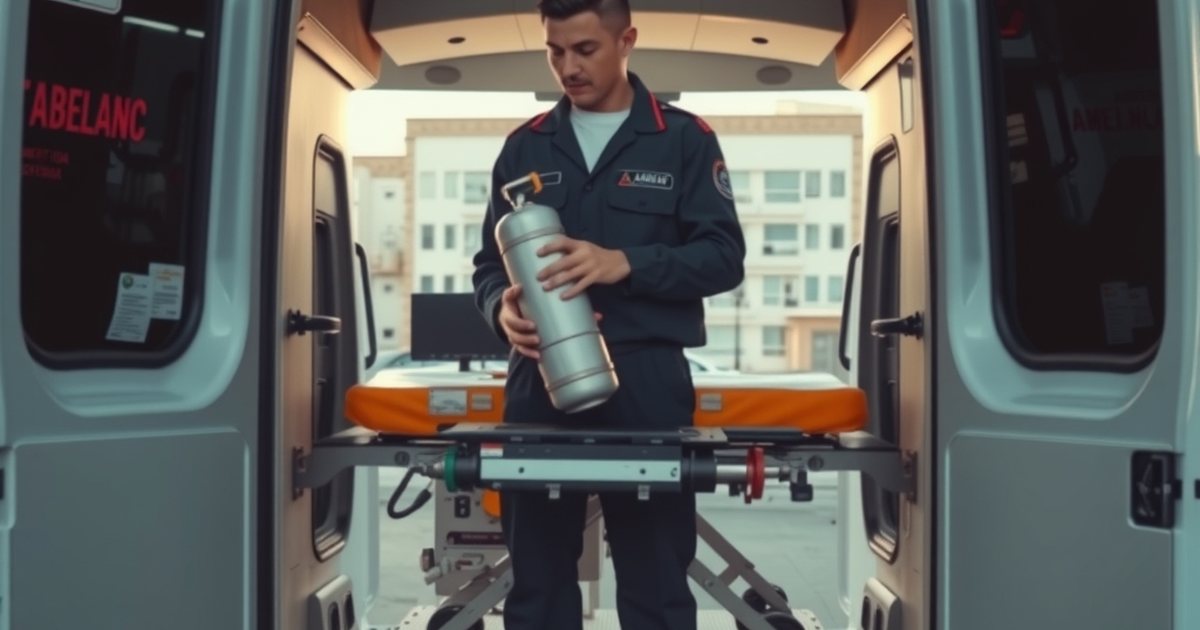
- Before leaving: an inspection round of the vehicle, making sure the oxygen cylinder is full and the stretcher and first aid bag are ready.
- Receiving the assignment: the address, the patient's condition, the name of the accompanying nurse or doctor, and the receiving institution.
- Transport: the shortest and most comfortable route for the patient, and smooth driving without sudden braking.
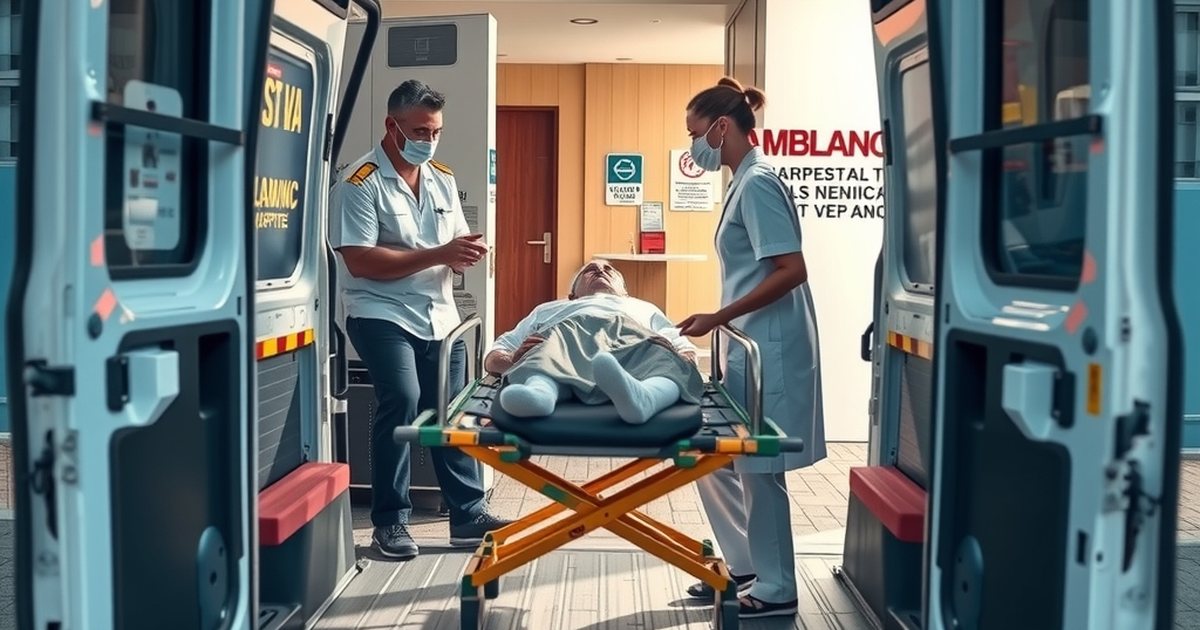
- On arrival: helping to unload the patient and hand him or her over to the department.
- After the mission: cleaning and disinfecting the patient compartment, and recording the mileage and time in the mission log.
What social security requires of the private carrier
The model agreement annexed to Executive Decree 07-218 (10 July 2007) between social security bodies and medical carriers obliges the carrier to do the following, obligations that the driver carries out in the field:
- Ensure a health worker is on board every medical vehicle in service.
- Be available day and night and on public holidays.
- Provide comfort for the patient and treat him or her with respect and care.
- Take the shortest and most suitable route when the patient is on board.
- Keep patients' appointment times.
Ambulance equipment every driver should know
Decree 07-218 distinguishes, in its reimbursement tariffs, three categories of vehicle: the medical ambulance, the health ambulance, and the light medical vehicle. The higher the category, the more equipment it carries and the greater the responsibility.
For comparison, the European standard EN 1789 classifies ambulances as: type A for patient transport (A1 without lights and siren, A2 with them), type B emergency ambulance, and type C mobile intensive care unit. This is a European standard cited for comparison only, not an Algerian text. The equipment a driver normally deals with:
- The main stretcher and its securing system, and the stair chair.
- The oxygen cylinder, its regulator, and how to check the remaining pressure.
- The first aid bag and dressing materials.
- The automated external defibrillator (AED) in vehicles equipped with one.
- The lights and siren, and the communication device.
- Disinfectants, gloves and medical waste containers.
The legal framework for private ambulance activity
The activity of "private ambulance services" (activity code 602104) is a regulated activity carried out under Law 18-11 of 2 July 2018 on health, as amended and supplemented, and requires an authorisation from the wilaya that must be obtained before registration in the commercial register, with a file including the articles of association, proof of qualification and conformity of the premises.
The relationship with social security is governed by Executive Decree 07-218: medical transport costs are reimbursed only on a medical prescription specifying the type of transport, except in cases of confirmed medical emergency, and provided the carrier meets the administrative, technical and medical conditions. The insured person has the right to choose any carrier they wish, without intervention from the social security body.
What this means for the driver: the company you work for must be authorised, and your vehicle must carry a health worker on board. Ask about the authorisation before accepting a job, because working for an unlicensed carrier puts you in a vulnerable position.
How to find a job as an ambulance driver
Three sources are enough to cover most opportunities, provided you follow them regularly.
- Public-sector notices: they are posted at the wilaya and local employment agencies; look there for "level 1 vehicle driver" posts at health directorates, hospital institutions and local health institutions.
- Private companies: the ambulancedz directory lists private carriers and ambulance drivers across the wilayas; browse it to see who works in your wilaya and contact them directly. An independent driver can also register there to become visible to patients and their families.
- Job offers on tkawen.com/jobs, where you can also showcase your digitally verified certificate in your professional profile.
Safety notice
Private ambulance directories are not an emergency call centre and do not replace the public emergency services. In a life-threatening situation, call Civil Protection first on 14.
Common mistakes when entering the profession
- Relying on unsourced published salary figures: ask the institution for the category and step, or ask for the contract in writing in the private sector.
- Applying for a level 2 post with only a category B licence: this post requires a heavy-goods or passenger-transport licence.
- Neglecting first aid on the grounds that the nurse will handle it: the driver is often the first to reach the patient and the last to leave.
- Accepting a job with a carrier without checking its wilaya authorisation.
- Driving fast instead of driving smoothly: sudden braking hurts the patient and can throw equipment around.
- Ignoring routine maintenance: a simple breakdown on the road can delay a patient in critical condition.
Checklist before you apply
- A valid driving licence of the category matching the vehicle (B at least).
- Two recent medical certificates.
- The national service status document (for men).
- A first aid training certificate from Civil Protection, the Red Crescent or a training provider.
- Work certificates proving driving experience, if you have any.
- Good knowledge of the wilaya's roads and health institutions.
Hire ambulance drivers with a certificate you can verify
If you run a medical transport company, the TKAWEN network includes talents holding the ambulance driver training certificate, and each certificate can be verified by QR code before hiring.
Enter the profession with both a driver's and a first aider's skills
An intensive in-person course: safe driving with a patient, equipment, and first aid during transport, with a digitally verified certificate that employers can check by QR code.
See the training programme →Frequently asked questions
How much does an ambulance driver earn in Algeria?
There is no single salary. In the public sector the post of "level 1 vehicle driver" is classified in category 2 of the contract-staff grid (Presidential Decree 07-308), and the actual amount is set by the institution according to the grid in force, seniority and allowances, so ask it for the category and step. In the private sector the contract sets it, and for full-time work it cannot be less than the national guaranteed minimum wage: 24,000 DZD since 1 January 2026.
Which driving licence does an ambulance driver need?
Category B is enough for vehicles whose authorised gross weight does not exceed 3,500 kg, and it is the requirement for level 1 posts. Heavier vehicles need a higher category, and the level 2 post requires a heavy-goods or passenger-transport licence.
How does the ambulance driver exam work?
In the public sector, recruitment is by a competition based on a professional test organised by the institution that posts the notice. Prepare for a practical driving test and questions on traffic rules, routine maintenance and knowledge of the roads, plus first aid basics.
What are the duties of a level 1 vehicle driver?
Driving light vehicles and carrying out their routine maintenance, as Decree 08-05 defines it for drivers in public administrations. In health institutions this is extended to transporting patients, checking equipment before every mission, and coordinating with the health attendant.
Where can I train in first aid in Algeria?
Civil Protection runs the "A First Aider in Every Family" programme for citizens, and the Algerian Red Crescent is active in first aid through its committees in every wilaya. For job-specific knowledge, TKAWEN offers an ambulance driver training course at tkawen.com/join/ambulance.
Must a private ambulance carry a nurse?
The social security model agreement (Executive Decree 07-218) obliges the medical carrier to ensure a health worker is on board every medical vehicle in service, and asks for copies of the certificates of its medical or paramedical staff in its file.
Does private ambulance activity require an authorisation?
Yes. "Private ambulance services" is a regulated activity (code 602104) that requires a wilaya authorisation before registration in the commercial register, under Law 18-11 on health.
How do I become an ambulance driver in Civil Protection?
Through the recruitment competitions for Civil Protection agents announced by the General Directorate of Civil Protection, with age, education and fitness requirements set by each competition, followed by internal training. There is no separate "ambulance driver" recruitment in this service.